


Who Buzzed: buzz & sporcle
Abdelrahman Sobhy
I found Who Buzzed: buzz & sporcle most enjoyable when I treated it as a social quiz rather than a solo knowledge test. The idea is simple: people answer trivia together, react quickly with party buzzers, and move between question formats that make guessing as important as remembering. That combination gives the game a livelier feel than a standard multiple-choice quiz, especially when everyone is sitting in the same room and nobody wants to be the first person to admit they have no idea.
It is a free trivia game from Abdelrahman Sobhy, available for Everyone and listed for devices running Android 7.0 or later. The game has reached over 100 thousand installs and carries a 4.8 average from around 1.9 thousand ratings, which matches my impression that its main appeal is immediate accessibility rather than a complicated long-term system. I could start a round without studying instructions or building a profile first. The useful question is not whether it contains enough content to replace every quiz app, but whether it gives a group a good reason to keep passing the phone around.
How the first few rounds establish a goal
The early goal is refreshingly clear: get involved before the room loses momentum. In a typical group session, the first few questions are less about proving expertise and more about learning how the buzzer and guessing flow affect the table. A confident player may rush in, while a cautious player waits for a clue or watches how others respond. That creates a small layer of strategy even when the question itself is familiar.
I like that the game’s social structure gives beginners something to do immediately. A person who is not strong at trivia can still enjoy predicting who will buzz, challenging an overconfident answer, or taking a chance on a question where the wording leaves room for interpretation. This matters at a party, because a quiz that rewards only the strongest general-knowledge player can make everyone else quiet after a few turns.
The early rounds also reveal whether your group prefers speed or discussion. The party buzzer idea naturally favors quick reactions, while guessing games encourage people to talk through possibilities. Those are different moods, and switching between them helps avoid the flat rhythm of reading one question after another. I would still explain the basic expectations before starting: decide who is answering, agree on whether players should wait for the prompt to finish, and keep the phone where everyone can see it.
Related News






That small setup is one of my practical tips. If the group begins without agreeing on turn-taking, the quickest person can dominate the first few questions and make the game feel unfair. When everyone understands that the buzzer is part of the fun rather than a way to interrupt constantly, the rounds become more balanced. The app provides the spark, but the group still supplies the house rules that make a party game work.
For a family gathering, I would use it as a short activity between conversations instead of announcing a long tournament. For a group of friends, I would let players rotate who holds the device or who reads the prompt, depending on how the round is presented. That keeps one person from becoming a permanent host and gives quieter players a more active role.
Progress feels social before it feels personal
One important detail is that the game’s progress is easiest to notice through the group’s changing behavior. At first, people answer cautiously because they are still learning the pace. A few rounds later, players recognize who reacts quickly, who guesses well, and who tends to overthink. Those informal rivalries become the main progress signal. I found myself remembering previous mistakes and adjusting my timing, even when the game did not need a traditional character or equipment upgrade to remain interesting.
Gallery
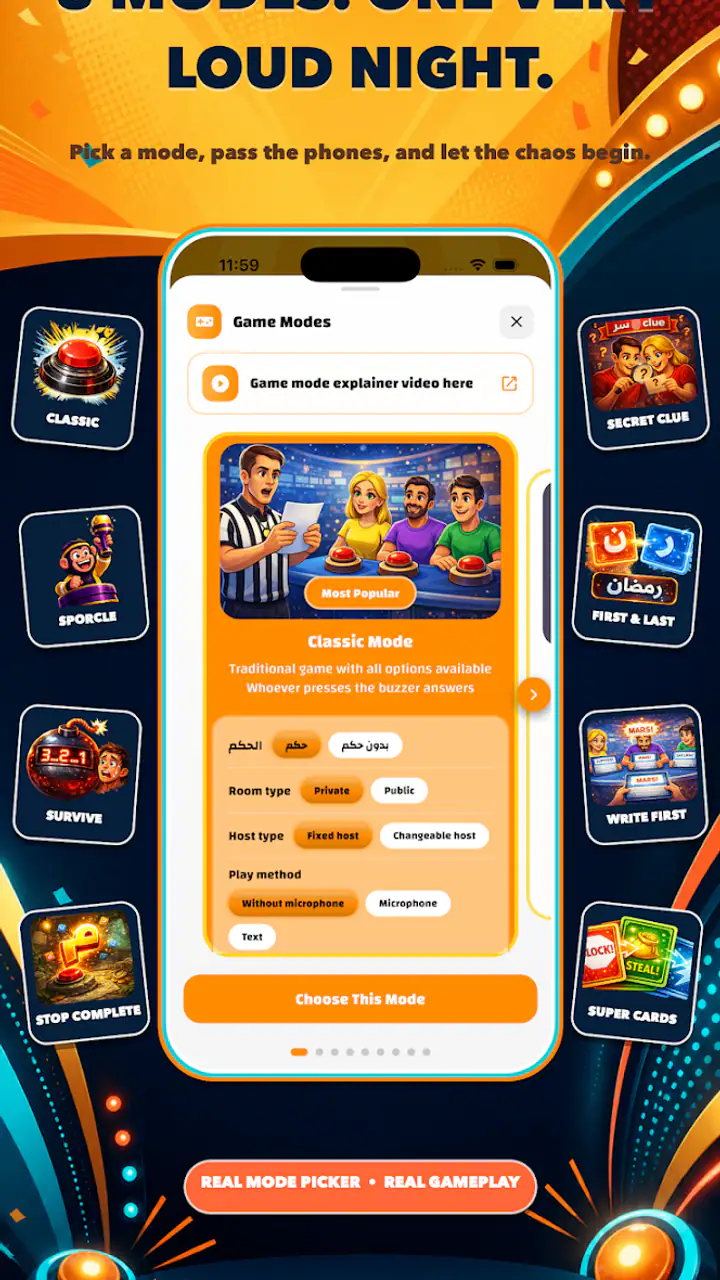
This is a different kind of progression from a solo trivia app. In a conventional quiz, progress often means moving through a level map, collecting points, or opening another subject area. Here, the meaningful advance is that the room becomes more coordinated and more competitive. Players learn when to wait, when to commit, and how to read the confidence behind another person’s answer. That learning curve is subtle, but it is exactly what gives repeat sessions some personality.
The guessing format is particularly useful for this. A player can improve without suddenly knowing more facts by becoming better at judging likely answers. That makes the game friendlier to mixed groups, although it also means that someone seeking a rigorous knowledge benchmark may find the experience less satisfying than a focused quiz with clearly graded individual results.
I would not mistake a high score in one gathering for a complete measure of trivia ability. The result can depend on reaction speed, familiarity with the topics that appear, and how willing someone is to take a risk. That is not a flaw in a party game, but it is worth understanding before using the app for a serious competition. If you want a quiet, carefully controlled test of knowledge, a traditional quiz format will probably suit you better.
Another useful tactic is to change the social arrangement rather than forcing the same players into the same roles. Letting the strongest player become the reader for one round can reduce the feeling that the session is always about defeating that person. In another round, placing people in pairs can help a less confident participant contribute without turning the game into a one-person show. These adjustments do more for replay value than pretending every group will enjoy identical rules.
Where the difficulty curve works and where it depends on the room
The difficulty in Who Buzzed: buzz & sporcle does not come only from the trivia itself. It also comes from deciding how quickly to respond and how much confidence to place in a first impression. A straightforward question can become tense when two people think they know the answer and both want to buzz first. A harder guessing prompt can be entertaining because nobody has complete certainty, but it can also feel arbitrary if the group expects every answer to be obvious.
That makes the curve flexible rather than strictly progressive. The challenge changes with the players, their backgrounds, and the energy in the room. A group with similar interests may move rapidly through familiar material, while a mixed-age family may find the same session unpredictable. I see this as a strength for casual play, because the game does not require everyone to be at the same knowledge level. The trade-off is that it is harder to judge whether a round was genuinely difficult or simply unfamiliar to the people playing.
My advice is to pay attention to the mood after a difficult question. If players laugh, argue playfully, and want to know the answer, the challenge has done its job. If everyone stops buzzing because they feel the outcome is a guess, the host should slow the pace and encourage discussion. The app’s most effective difficulty setting is often the group’s own attitude: fast and competitive for confident players, more conversational for families or first-time users.
This is also where the game differs from many standard trivia alternatives. A solo quiz usually gives you time to read, think, and submit. A board-style trivia game often has a fixed turn order and physical components that make the rules visible. This app sits between those models. It brings the immediacy of a buzzer to a phone while keeping the low setup of a digital quiz. I would choose it over a conventional quiz when the goal is noise, reaction, and shared jokes. I would choose a more structured alternative when accuracy, balanced turns, or detailed performance tracking matters most.
The device itself can become part of the difficulty. In a crowded room, people may not see the screen equally well, and a player holding the phone can unintentionally control the pace. I recommend placing it in the center or handing it to a neutral person between rounds. That is a small change, but it prevents the strongest personality from also controlling the information everyone else receives.
What keeps a group playing after the novelty
The retention pressure here is social rather than built around a complicated unlock path. People continue because they want another chance after a near miss, because someone made a funny wrong guess, or because the current leader has become a target. That is a healthy reason to replay the game, provided the group enjoys the interaction itself. It does not need to manufacture a deep solo grind to justify another round.
At the same time, this means the game’s staying power depends heavily on having suitable people available. If you usually play alone, the central appeal becomes much weaker. The same is true if your friends dislike fast reactions or become uncomfortable with public mistakes. I would skip this title for a private, methodical study session and pick it for evenings when conversation and competition can overlap.
The free entry point makes trying it with a group easy. There are in-app purchases ranging from $0.39 to $5.99 per item, so I would approach those as optional spending rather than part of the basic decision to install. A useful habit is to play several sessions first and decide whether the available experience already fits your group. If the core rounds are not fun without extra spending, purchasing something will not fix the social mismatch.
Because the game is rated Everyone, it is a reasonable candidate for mixed-age casual play, but the actual atmosphere still comes from the questions and the people answering them. Adults should guide younger players if a prompt creates confusion or if the group becomes too competitive. The age label makes the app broadly approachable; it does not remove the need for ordinary judgment about how a particular gathering should play.
Version 1.4.23 is the current version I would look for when installing, and the Android requirement is modest enough to include older compatible devices. That is helpful for a family group where not everyone owns a recent phone. Still, for a party session, I would test the device and sound setup before guests arrive. The most frustrating interruption in this kind of game is not a difficult question; it is discovering that nobody can comfortably see or hear what is happening.
Three practical ways to get more from the format
First, use short themed sessions created by the group’s conversation rather than trying to make every round feel like a formal contest. If people were discussing films, travel, food, or school memories, let that interest guide the way they react to the next questions. The point is not to invent unsupported game modes, but to use the existing trivia and guessing structure as a bridge back into the conversation.
Second, separate speed from confidence when judging a player’s performance. The person who buzzes first is not necessarily the person who understands the question best. After a few rounds, I would deliberately give slower players a chance to answer before the quickest reaction takes over. This makes the session more enjoyable for mixed groups and reveals a different kind of skill: recognizing an answer without needing to win every race to the buzzer.
Third, stop while the room is still engaged. A common mistake with party games is continuing until people are checking their phones. Since the appeal comes from shared energy, a compact session that ends after a memorable comeback is better than stretching the same rhythm too far. You can always return to it later, and the unfinished rivalry becomes a reason to play again rather than a sign that the app ran out of value.
A fourth tip is to treat wrong answers as material for conversation instead of evidence that someone is bad at trivia. The guessing elements work best when players can explain why an answer seemed plausible. That turns a miss into a small story and reduces the pressure on people who do not normally volunteer answers. In my experience, this is the difference between a group that laughs together and a group that quietly lets one expert answer everything.
Who should install it, and who should pass
I recommend it to friends who want a quick party activity that needs little preparation. It is especially suitable when the group enjoys calling out answers, making predictions, and teasing one another in good faith. Families may also appreciate the broad age rating and accessible premise, as long as an adult is willing to manage the pace and keep the competition friendly.
I would be more cautious for players looking for a deep personal progression system. The game’s goals and rewards are most convincing when they emerge from the people around the phone, not from a long solo journey. If your ideal trivia experience includes extensive statistics, a carefully escalating curriculum, or a quiet practice mode, a dedicated knowledge app may be a better match.
It is also not my first choice for a large gathering where everyone needs a perfectly equal view and a clearly documented score. The buzzer format can become messy when too many voices compete at once. In that situation, splitting guests into smaller groups or using it as one station among several activities would work better than expecting one phone-based round to organize the entire event.
My verdict on its long-term pacing
Who Buzzed: buzz & sporcle succeeds because its progression is felt through rising confidence, sharper timing, and the stories that form around wrong answers. Its early goals are easy to understand, its challenge shifts naturally with the group, and its retention comes from unfinished rivalries rather than an exhausting checklist. That makes it a strong casual choice, even though it is not designed to replace a structured solo trivia trainer.
I would install it before a relaxed game night, a family visit, or a short break when several people want to do something together without learning a complicated rulebook. I would skip it when I am alone, when the room dislikes public guessing, or when I need precise individual assessment. The free price makes experimentation straightforward, while the optional purchases give the app room for spending without making that the center of the experience.
Overall, Abdelrahman Sobhy’s trivia game understands that a buzzer can be as entertaining as the answer. The best moments come from hesitation, overconfidence, sudden guesses, and the player who seemed out of the running until one question changed the room. Its strongest feature is the shared tension created by answering together, and if that is what you want from a quiz night, this is an easy recommendation.
FAQs for Who Buzzed: buzz & sporcle
What is Who Buzzed: buzz & sporcle?
Who Buzzed: buzz & sporcle is a group party game designed for quick, competitive rounds with friends. Players use their phones to react, answer, or buzz in during different challenges, making it suitable for gatherings, family game nights, and casual social sessions. The experience focuses on speed, general knowledge, and playful competition rather than long, complicated gameplay.
How do you play Who Buzzed: buzz & sporcle?
The game typically works by having players join the same session and follow the instructions shown on the screen. Depending on the selected activity, participants may need to buzz first, answer a question, or complete a short challenge. The app keeps track of timing and results, so everyone can easily see who reacted fastest or earned the most points during the round.
Can I play Who Buzzed: buzz & sporcle with friends or family?
Yes, the app is mainly intended for multiplayer entertainment with friends, relatives, or other people in the same room. It is most enjoyable when each participant has access to a compatible device and everyone agrees on the game rules before starting. Because rounds are usually short, players can quickly rotate turns and include larger groups without lengthy preparation.
Does Who Buzzed: buzz & sporcle require an internet connection?
Whether an internet connection is necessary can depend on the specific mode, device setup, and version of the application. Some features may work locally for people playing together, while online functions, updates, account services, or additional content may require connectivity. It is a good idea to install the latest version and check the app’s current store description before relying on it offline.
Is Who Buzzed: buzz & sporcle free to download and suitable for children?
The application may be available to download at no initial cost, although advertisements, optional purchases, or premium features can vary by platform and region. Parents should review the current age rating, privacy information, and in-app purchase settings before allowing children to use it. Since the game involves quizzes and social competition, suitability may also depend on the selected content and the players’ ages.
Pros
- Quick
- casual rounds are ideal for filling short breaks.
- A wide variety of topics keeps quizzes from feeling repetitive.
- Simple controls make it easy for new players to start.
- Competitive scoring adds motivation to replay quizzes.
- Useful for discovering interesting facts while playing.
Cons
- Some questions may feel too easy for experienced trivia players.
- The experience can depend heavily on having active opponents.
- Ads may interrupt the flow between games or quiz rounds.
- Certain features or content may require in-app purchases.
- Question quality and difficulty may vary across different topics.


